
Best Peptides for Muscle Recovery: The Complete Research Guide (2026) | SinoPepLab Germany

Introduction
Muscle recovery remains one of the most important areas of modern peptide research. Around the world, biotechnology laboratories, regenerative medicine researchers, pharmaceutical companies, sports science institutions, and academic researchers continue investigating how specific research peptides interact with biological pathways involved in tissue repair, inflammation, collagen production, angiogenesis, and cellular signaling.
Rather than focusing on a single molecule, today’s research increasingly evaluates combinations of peptides that influence different biological mechanisms. Among the most studied are BPC-157, TB-500, GHK-Cu, CJC-1295, and Ipamorelin, each of which has attracted significant scientific interest because of its distinct mechanism of action.
At SinoPepLab, we support laboratory research by supplying high-purity research peptides manufactured according to rigorous German quality standards. Every production batch undergoes strict analytical quality control designed to provide researchers with consistent materials suitable for laboratory investigations.
Our quality system includes:
.German Quality Standards
.HPLC Purity Analysis
.Sterility Testing
.Endotoxin Testing
.Certificate of Analysis (COA) with Every Batch
.Batch-to-Batch Consistency
.Worldwide Shipping
.Dedicated Scientific Customer Support
.Bulk Quantities
.Custom Manufacturing Solutions
Because reproducibility is essential in peptide research, consistency between batches is a critical component of reliable experimental design. Researchers require analytical documentation that allows results to be interpreted with confidence, making quality assurance just as important as peptide selection itself.
This comprehensive guide explores the five leading research peptides most frequently investigated for muscle recovery-related laboratory studies:
.BPC-157
.TB-500
.GHK-Cu
.CJC-1295
.Ipamorelin
Throughout this guide, we examine their biological mechanisms, current areas of scientific investigation, laboratory applications, manufacturing quality considerations, and best practices for sourcing high-quality research peptides.
Unlike many articles that focus primarily on product promotion, this guide emphasizes scientific understanding, laboratory quality, and responsible research practices while helping researchers understand why manufacturing standards play such an important role in peptide-based investigations.
Why Muscle Recovery Research Matters
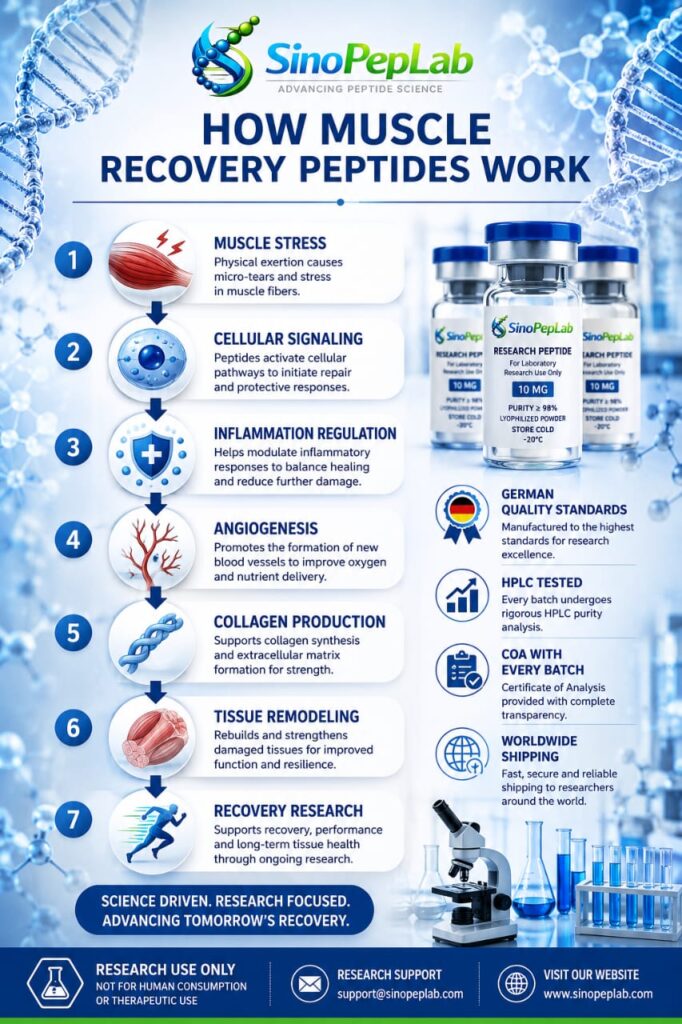
Muscle tissue continuously adapts to mechanical stress, exercise, injury models, and aging-related biological changes. These processes involve a complex interaction of inflammatory mediators, extracellular matrix remodeling, collagen synthesis, stem cell activation, angiogenesis, and growth factor signaling.
Researchers studying muscle biology aim to better understand:
.Cellular repair mechanisms
.Connective tissue remodeling
.Satellite cell activation
.Growth factor signaling pathways
.Collagen organization
.Vascular regeneration
.Inflammatory regulation
.Recovery following mechanical stress
.Age-related tissue changes
Research peptides provide valuable experimental tools for investigating these biological processes under controlled laboratory conditions.
Understanding Muscle Recovery Research
Muscle recovery is one of the fastest-growing fields in peptide research. Modern laboratories investigate how naturally occurring signaling peptides influence cellular communication, tissue remodeling, collagen production, angiogenesis, inflammatory responses, and protein synthesis.
Unlike traditional pharmaceutical compounds that often target a single receptor, research peptides are generally studied because they interact with naturally occurring biological pathways involved in tissue maintenance and repair.
For biotechnology laboratories, regenerative medicine researchers, pharmaceutical companies, and sports science institutions, muscle recovery research is not simply about rebuilding damaged tissue—it is about understanding the biological mechanisms that regulate healing, adaptation, and regeneration.
This is why researchers require highly characterized peptides with documented purity and batch consistency.
At SinoPepLab, every production batch is manufactured following German quality standards and undergoes comprehensive laboratory testing before release.
Our quality system includes:
.HPLC Purity Analysis
.Sterility Testing
.Endotoxin Testing
.Certificate of Analysis (COA) with Every Batch
.Batch-to-Batch Consistency
.Worldwide Shipping
.Dedicated Research Customer Support
.Bulk Quantities
.Custom Manufacturing
Reliable analytical documentation allows researchers to work with confidence, improving reproducibility across multiple experiments.
Why Quality Matters in Peptide Research
One of the greatest challenges in peptide research is experimental reproducibility.
Two laboratories studying identical biological pathways can produce different results if peptide quality varies.
Researchers therefore place considerable emphasis on:
Purity
Higher analytical purity reduces impurities that may influence experimental outcomes.
At SinoPepLab, every batch undergoes HPLC purity analysis to verify composition before release.
Sterility
Research involving cell cultures and sensitive laboratory environments requires sterile materials to minimize contamination risks.
Every SinoPepLab batch undergoes sterility testing before distribution.
Endotoxin Testing
Endotoxins can interfere with biological experiments by introducing unwanted inflammatory responses.
Routine endotoxin testing helps researchers maintain confidence in experimental materials.
Batch-to-Batch Consistency
Scientific research depends upon reproducibility.
Maintaining consistency between production batches allows laboratories to repeat experiments using comparable materials.
Certificate of Analysis (COA)
Every SinoPepLab production batch includes a Certificate of Analysis documenting analytical results and quality specifications.
Researchers can use this documentation when verifying laboratory materials before beginning experimental work.
The Five Most Studied Muscle Recovery Peptides
Although hundreds of peptides exist, five continue to receive significant attention within muscle recovery research.
These include:
1. BPC-157
BPC-157 is among the most widely discussed peptides in tissue repair research.
Researchers continue investigating its role in:
.Tendon biology
.Ligament models
.Muscle recovery pathways
.Angiogenesis
.Connective tissue research
.Cellular migration
.Inflammatory signaling
Its diverse biological activity has made it one of the most studied peptides within regenerative medicine research.
2. TB-500
TB-500 is a synthetic peptide studied because of its relationship to thymosin beta-4, a naturally occurring protein involved in cellular movement and tissue organization.
Current laboratory investigations explore:
.Cell migration
.Cytoskeletal organization
.Blood vessel formation
.Tissue remodeling
.Muscle regeneration pathways
.Connective tissue biology
Researchers frequently study TB-500 alongside other peptides to better understand complementary biological pathways.
Why Researchers Often Study BPC-157 and TB-500 Together
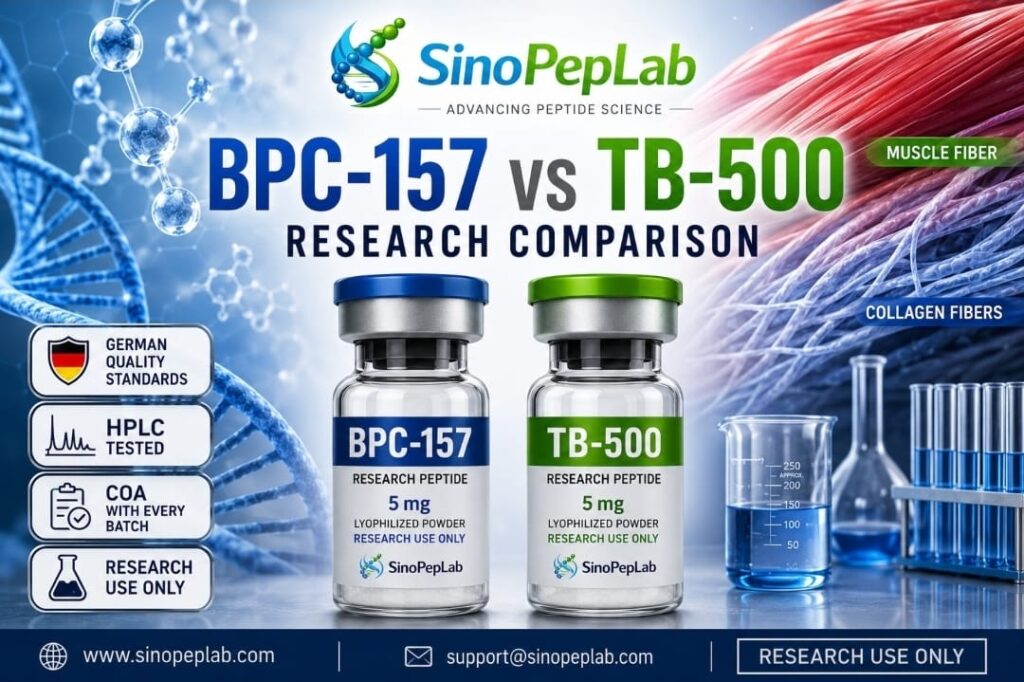
Rather than viewing these peptides as competitors, many research programs investigate how they influence different biological pathways involved in tissue remodeling.
Broadly speaking:
BPC-157 research often focuses on:
.Connective tissue biology
.Tendon models
.Ligament studies
.Gastrointestinal tissue research
.Angiogenesis
TB-500 research often focuses on:
.Cell migration
.Cytoskeletal dynamics
.Tissue organization
.Blood vessel development
.Muscle remodeling
Because these mechanisms differ, researchers may explore them separately or in combination depending on the scientific question being investigated.
GHK-Cu, CJC-1295 & Ipamorelin: Understanding Their Role in Muscle Recovery Research
As peptide science continues to evolve, researchers increasingly recognize that muscle recovery involves multiple biological systems rather than a single repair mechanism. While BPC-157 and TB-500 are commonly investigated for connective tissue and regeneration research, other peptides—including GHK-Cu, CJC-1295, and Ipamorelin—are studied for their potential influence on cellular signaling, growth hormone pathways, extracellular matrix biology, and tissue remodeling.
Each peptide offers researchers a different perspective on muscle biology, making them valuable tools for laboratory investigations.
At SinoPepLab, our research peptides are manufactured according to German quality standards and undergo strict quality control before release.
Every batch includes:
.HPLC Purity Analysis
.Sterility Testing
.Endotoxin Testing
.Certificate of Analysis (COA) with Every Batch
.Batch-to-Batch Consistency Verification
Available through:
.Bulk quantities
.Custom manufacturing
.Worldwide shipping
.Dedicated research customer support
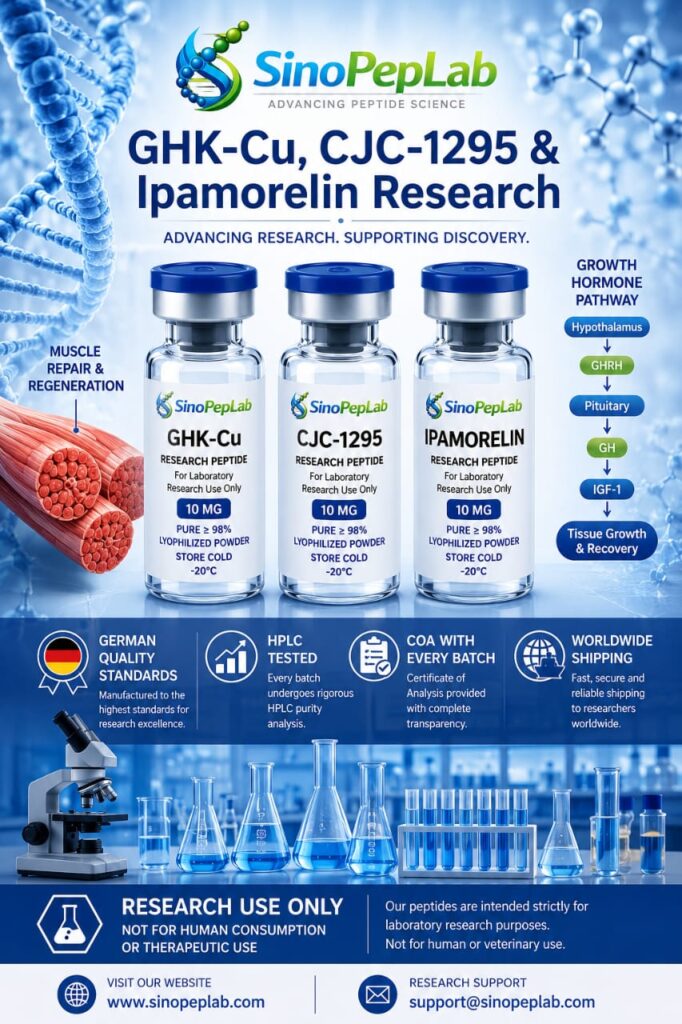
GHK-Cu Research
GHK-Cu (Glycyl-L-Histidyl-L-Lysine Copper Complex) is one of the most extensively studied copper-binding peptides in laboratory research.
Researchers investigate GHK-Cu because of its involvement in:
.Skin biology
.Extracellular matrix remodeling
.Fibroblast signaling
.Collagen-related research
.Connective tissue organization
.Cellular communication
Within muscle recovery research, scientists continue exploring how GHK-Cu may influence extracellular matrix biology and tissue remodeling under controlled laboratory conditions.
Current areas of investigation include:
.Collagen biology
.Fibroblast activity
.Protein regulation
.Oxidative stress pathways
.Connective tissue organization
These studies help researchers better understand how biological tissues maintain structure and respond to physiological stress.
CJC-1295 Research
CJC-1295 is a synthetic peptide investigated because of its interaction with growth hormone-releasing hormone (GHRH) pathways.
Researchers use CJC-1295 to study:
.Growth hormone signaling
.Endocrine regulation
.Protein metabolism
.Cellular communication
.Muscle biology
.Tissue adaptation
Rather than directly repairing tissue, CJC-1295 serves as a valuable research tool for understanding hormonal signaling involved in growth and recovery processes.
Laboratory investigations continue examining how modulation of GHRH pathways influences biological systems associated with muscle physiology.
Ipamorelin Research
Ipamorelin is another peptide frequently investigated alongside CJC-1295 in laboratory settings.
Scientists study Ipamorelin because it interacts with ghrelin receptor pathways involved in growth hormone regulation.
Current research includes:
.Endocrine biology
.Growth hormone secretion pathways
.Protein synthesis research
.Muscle metabolism
.Recovery-related cellular signaling
Its selective mechanism has made it an important molecule for researchers investigating hormonal regulation in experimental models.
Comparing the Three Peptides
| Research Peptide | Primary Research Focus |
| GHK-Cu | Skin Biology , Collagen Research , Extracellular Matrix Remodeling |
| CJC-1295 | Growth hormone -releasing hormone pathways, endocrine research |
| Ipamorelin | Ghrelin receptor signaling, growth hormone regulation |
Each peptide contributes to a different aspect of muscle recovery research, allowing scientists to investigate complementary biological pathways rather than relying on a single experimental model.
Why Manufacturing Quality Matters
Research outcomes depend heavily on the quality and consistency of the materials used.
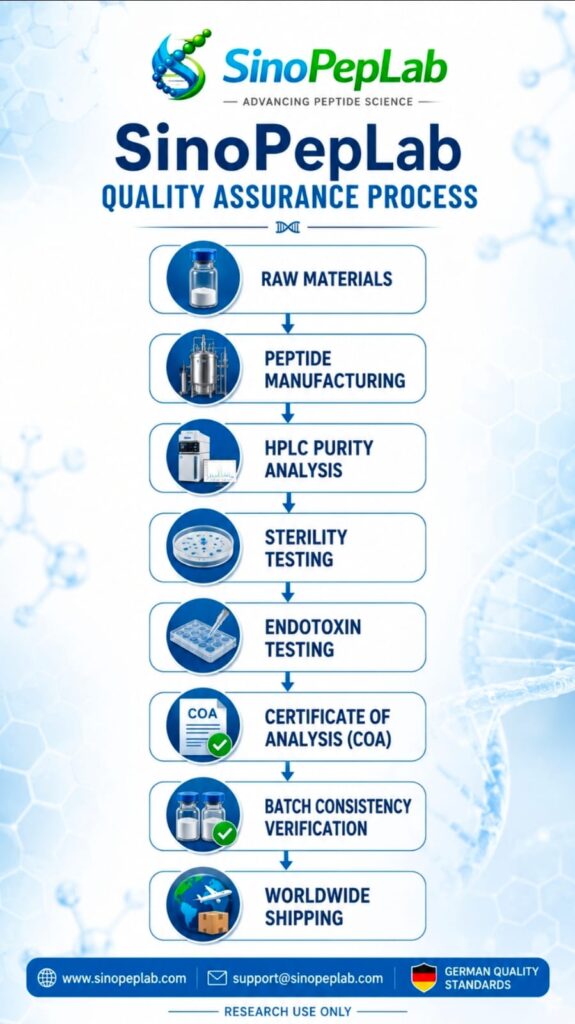
At SinoPepLab, every production batch undergoes a comprehensive quality assurance process that includes:
.HPLC Purity Analysis to verify peptide purity.
.Sterility Testing to support research-grade manufacturing.
.Endotoxin Testing for quality assurance.
.Certificate of Analysis (COA) with every batch.
.Batch-to-Batch Consistency to support reproducible laboratory research.
These quality measures help researchers work with well-characterized peptide materials suitable for scientific investigations.
Why Researchers Choose SinoPepLab
Researchers worldwide choose SinoPepLab because we emphasize quality, transparency, and scientific support.
Our advantages include:
.German quality standards
.High-purity research peptides
.HPLC purity analysis
.Sterility testing
.Endotoxin testing
.COA with Every Batch
.Batch-to-Batch Consistency
.Bulk research quantities
.Custom peptide manufacturing
.Worldwide shipping
.Dedicated customer support
Every SinoPepLab product is supplied strictly for laboratory research purposes only and is not intended for human consumption, diagnosis, treatment, or prevention of disease.
Choosing High-Quality Muscle Recovery Research Peptides
One of the most overlooked factors in peptide research is the quality of the research material itself. Regardless of how well a laboratory study is designed, inconsistent or poorly characterized peptides can introduce variability that affects reproducibility and confidence in experimental findings.
For this reason, experienced researchers evaluate peptide suppliers based on analytical testing, manufacturing standards, quality documentation, and consistency—not solely on price.
At SinoPepLab, every research peptide is manufactured according to German quality standards, supported by comprehensive analytical testing, and supplied with transparent documentation to help researchers work with confidence.
Why Quality Matters in Peptide Research
Research peptides are used to investigate complex biological processes. Small differences in purity, manufacturing methods, or storage conditions may influence laboratory outcomes.
When selecting a peptide supplier, researchers should consider:
.Manufacturing quality
.Analytical verification
.Batch consistency
.Product documentation
.Technical support
.Shipping and storage standards
Reliable quality systems help support reproducible and scientifically meaningful research.
HPLC Purity Analysis
High-Performance Liquid Chromatography (HPLC) is one of the most widely used analytical techniques for evaluating peptide purity.
Researchers use HPLC to:
.Verify peptide purity
.Detect impurities
.Confirm manufacturing consistency
.Support batch quality assessment
At SinoPepLab, every batch undergoes HPLC purity analysis before release.
Sterility Testing
Sterility testing is an important part of research-grade manufacturing.
It helps verify that production processes meet defined quality standards and supports laboratories working with sensitive experimental systems.
Every SinoPepLab batch undergoes sterility testing before distribution.
Endotoxin Testing
Endotoxins are bacterial components that can interfere with certain laboratory experiments.
Testing for endotoxins helps ensure that research materials meet established quality specifications, particularly for biological and cell-based research.
Endotoxin testing forms part of SinoPepLab’s quality assurance program.
Certificate of Analysis (COA)
Each SinoPepLab research peptide is supplied with a Certificate of Analysis (COA).
A COA provides researchers with important information, including:
.Product name
.Batch number
.Analytical methods
.Purity results
.Manufacturing information
.Storage recommendations
This documentation supports transparency and quality assurance throughout the research process.
Batch-to-Batch Consistency
Long-term research projects often require multiple production batches over time.
Maintaining consistency between batches helps researchers:
.Repeat experiments with confidence
.Reduce variability
.Improve reproducibility
.Compare experimental data more effectively
SinoPepLab follows standardized manufacturing procedures to help maintain consistent product quality.
Why German Quality Standards Matter
Germany is recognized globally for precision manufacturing and scientific quality systems.
At SinoPepLab, these principles guide every stage of production, from raw material selection to analytical testing and final documentation.
Our commitment includes:
.Standardized manufacturing procedures
.Quality-focused production
.Comprehensive testing
.Transparent documentation
.Continuous quality monitoring
Laboratory Storage and Handling
Proper handling and storage are essential for maintaining peptide quality.
Researchers should:
Store peptides according to the manufacturer’s recommendations.
Protect products from excessive heat, light, and moisture.
Use clean laboratory equipment.
Record batch numbers for traceability.
Minimize unnecessary handling of lyophilized peptides.
Follow validated laboratory protocols.
These practices help preserve product integrity and support reliable experimental outcomes.
Available Muscle Recovery Research Peptides
SinoPepLab supplies research peptides commonly investigated in muscle recovery research, including:
.BPC-157
.TB-500
.GHK-Cu
.CJC-1295
.Ipamorelin
We also provide:
.Bulk quantities
.Custom peptide manufacturing
.Worldwide shipping
.Dedicated customer support
All products are supplied strictly for laboratory research purposes only.
Why Researchers Choose SinoPepLab
Researchers around the world choose SinoPepLab because we prioritize quality, transparency, and scientific support.
Our advantages include:
✔ German quality standards
✔ HPLC Purity Analysis
✔ Sterility Testing
✔ Endotoxin Testing
✔ Certificate of Analysis (COA) with Every Batch
✔ Batch-to-Batch Consistency
✔ Bulk Orders
✔ Custom Manufacturing
✔ Worldwide Shipping
✔ Dedicated Customer Support
Our mission is to provide dependable research materials that help advance peptide science and support reproducible laboratory investigations.
Frequently Asked Questions (Part 1)
What are muscle recovery research peptides?
Muscle recovery research peptides are compounds investigated in laboratory settings to better understand biological processes such as tissue remodeling, extracellular matrix organization, cellular signaling, and protein regulation.
Why is HPLC testing important?
HPLC helps verify peptide purity and detect impurities, supporting consistent research materials.
What is a Certificate of Analysis (COA)?
A COA is a document that provides batch-specific analytical and quality information for a research peptide.
Why is batch consistency important?
Consistent manufacturing helps researchers reproduce experiments using comparable materials over time.
Are SinoPepLab peptides intended for human use?
No. All SinoPepLab products are supplied strictly for laboratory research purposes only and are not intended for human consumption, diagnosis, treatment, or prevention of disease.
Frequently Asked Questions, Why Researchers Choose SinoPepLab
As scientific interest in muscle biology and regenerative research continues to grow, research peptides remain valuable tools for studying the molecular pathways involved in tissue remodeling, cellular communication, extracellular matrix organization, and recovery-related biological processes. Peptides such as BPC-157, TB-500, GHK-Cu, CJC-1295, and Ipamorelin are each investigated for different mechanisms, providing researchers with opportunities to explore complementary aspects of muscle recovery in controlled laboratory settings.
Selecting high-quality research materials is essential for generating reliable and reproducible data. At SinoPepLab, we are committed to supporting the global research community by supplying high-purity research peptides manufactured according to German quality standards. Every batch is backed by rigorous quality testing, transparent documentation, and dedicated customer support.

1. What are the most researched peptides for muscle recovery?
Among the most commonly studied peptides in laboratory research are BPC-157, TB-500, GHK-Cu, CJC-1295, and Ipamorelin. Each is investigated for different biological pathways, including tissue remodeling, extracellular matrix biology, cellular signaling, and endocrine regulation.
2. Why are these peptides studied together?
Researchers may study these peptides together because they target different biological mechanisms, helping scientists investigate how multiple pathways contribute to muscle recovery and tissue biology.
3. What is BPC-157 researched for?
BPC-157 is investigated in laboratory models involving connective tissue biology, angiogenesis, gastrointestinal tissue, inflammatory signaling, and cellular repair mechanisms.
4. What is TB-500 researched for?
TB-500 is studied for its relationship with cell migration, tissue organization, cytoskeletal dynamics, angiogenesis, and regenerative biology.
5. What is GHK-Cu researched for?
GHK-Cu is widely investigated in studies involving skin biology, collagen research, extracellular matrix remodeling, fibroblast signaling, and connective tissue organization.
6. Why are CJC-1295 and Ipamorelin important in research?
These peptides are commonly studied because they interact with growth hormone-related pathways, allowing researchers to investigate endocrine signaling and protein metabolism in laboratory models.
7. Why is HPLC purity analysis important?
HPLC helps verify peptide purity and detect impurities, supporting consistent and reproducible research materials.
8. What is sterility testing?
Sterility testing helps verify that manufacturing processes meet research-grade quality standards and supports the integrity of laboratory materials.
9. What is a Certificate of Analysis (COA)?
A COA is a batch-specific document that provides information such as purity results, analytical methods, and product identification, helping researchers verify the quality of their materials.
10. Why is batch-to-batch consistency important?
Consistency between production batches helps researchers reproduce experiments over time using comparable materials, reducing variability.
11. Does SinoPepLab offer bulk quantities?
Yes. SinoPepLab supplies bulk research quantities and provides custom peptide manufacturing solutions for qualified research organizations.
12. Does SinoPepLab ship worldwide?
Yes. We provide worldwide shipping and dedicated customer support to laboratories, biotechnology companies, pharmaceutical organizations, and academic institutions.
13. Are SinoPepLab products intended for human use?
No. All SinoPepLab research peptides are supplied strictly for laboratory research purposes only and are not intended for human consumption, diagnosis, treatment, or prevention of disease.
Comparison of Common Muscle Recovery Research Peptides
| Peptides | Primary Research Areas |
| BPC-157 | Connective tissue biology , Angiogenesis gastrointestinal research |
| TB-500 | Cell migration , tissue remodeling , Cytoskeletal Organization |
| GHK-Cu | Skin Biology , Collagen research , Extracellular Matrix Remodeling |
| CJC-1295 | Growth Hormone-releasing hormone pathways endocrine research |
| Ipamorelin | Ghrelin receptor signaling , Growth hormone regulation |
Why Researchers Choose SinoPepLab
Researchers worldwide trust SinoPepLab because we prioritize manufacturing quality, scientific transparency, and dependable customer support.
Our commitment includes:
.German Quality Standards
.HPLC Purity Analysis
.Sterility Testing
.Endotoxin Testing
.Certificate of Analysis (COA) with Every Batch
.Batch-to-Batch Consistency
.Bulk Research Quantities
.Custom Manufacturing
.Worldwide Shipping
.Dedicated Customer Support
Every product is manufactured to support high-quality laboratory research and analytical investigations.
Explore SinoPepLab’s Research Peptide Portfolio
SinoPepLab supplies a wide range of research peptides, including:
Whether your work involves regenerative medicine, biotechnology, sports science, or peptide chemistry, our goal is to provide well-characterized research materials supported by rigorous quality systems.
Contact SinoPepLab
Browse Muscle Recovery Research Peptides
Explore our collection of premium research peptides designed for biotechnology laboratories, pharmaceutical research organizations, and academic institutions.
Request Bulk Orders
Need larger quantities? Contact our team to discuss bulk purchasing and custom manufacturing solutions.
Final Conclusion
Muscle recovery research continues to be one of the most dynamic fields in peptide science. By investigating peptides such as BPC-157, TB-500, GHK-Cu, CJC-1295, and Ipamorelin, researchers gain valuable insights into cellular signaling, tissue remodeling, extracellular matrix biology, and endocrine pathways that contribute to our understanding of muscle physiology.
At SinoPepLab, we support these scientific efforts by manufacturing research peptides according to German quality standards, backed by HPLC Purity Analysis, Sterility Testing, Endotoxin Testing, Batch-to-Batch Consistency, and a Certificate of Analysis (COA) with every batch. Our commitment to quality, transparency, and responsive support helps researchers obtain dependable materials for laboratory investigations.
All SinoPepLab products are supplied strictly for laboratory research purposes only. They are not intended for human consumption, diagnosis, treatment, or prevention of disease.



Comment
Where Can Researchers Buy High-Purity Research Peptides In Germany & Europe? | SinoPepLab
[…] .Growth Hormone Research […]