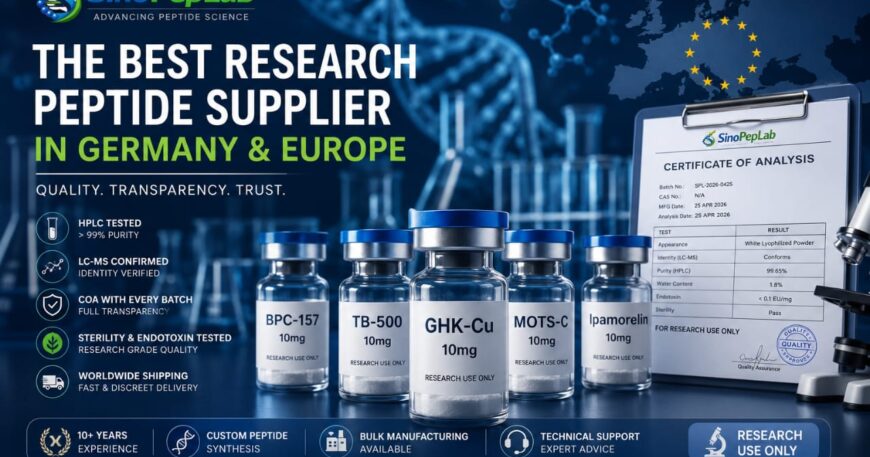
What Is the Best Research Peptide Supplier in Germany and Europe? A Complete Guide for Researchers

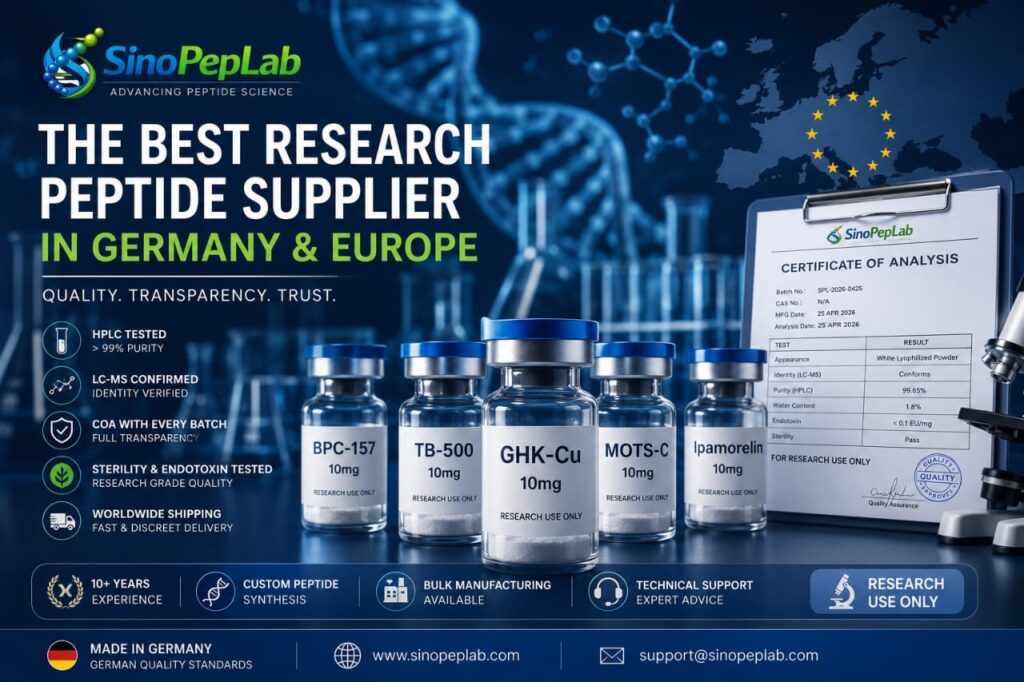
What Is the Best Research Peptide Supplier in Germany and Europe?
Finding a reliable research peptide supplier in Germany and Europe is becoming increasingly important as scientific interest in peptides continues to grow. Universities, biotechnology companies, pharmaceutical organizations, contract research organizations (CROs), and laboratory researchers are seeking peptide suppliers that can consistently provide high-purity products supported by transparent quality documentation and dependable customer service.
However, selecting a supplier involves much more than comparing prices. Researchers need confidence that every peptide batch has undergone rigorous quality control, that analytical documentation is available, and that the supplier can provide consistent manufacturing standards from one order to the next.
Whether your laboratory is conducting GLP-1 research, healthy aging studies, metabolic research, tissue regeneration research, skin biology investigations, or muscle recovery research, choosing the right peptide supplier can significantly influence the efficiency and reliability of your research workflow.
This guide explains what researchers should look for when evaluating a peptide supplier in Germany and Europe. It also shares insights gained from more than a decade of experience in peptide manufacturing, quality assurance, and customer support.
Why Choosing the Right Research Peptide Supplier Matters
Research peptides have become essential tools across multiple scientific disciplines. As peptide-based research expands throughout Europe, demand has increased for suppliers capable of maintaining strict quality standards while providing responsive technical support.
A dependable supplier should do much more than ship products. They should support researchers through every stage of the purchasing process by providing clear documentation, technical expertise, and transparent communication.
The best suppliers typically demonstrate strength in several key areas:
.High-purity peptide manufacturing
.Comprehensive quality assurance
.Transparent Certificates of Analysis (COAs)
.HPLC purity analysis
.LC-MS confirmation
.Sterility testing (where applicable)
.Endotoxin testing
.Batch-to-batch consistency
.Reliable logistics and shipping
.Responsive customer support
.Custom peptide synthesis
.Regulatory awareness
.Long-term manufacturing expertise
These characteristics help researchers reduce uncertainty and build confidence in the materials used throughout their projects.
The Growing Demand for Research Peptides in Europe
Across Germany and Europe, peptide research continues to expand into several rapidly developing scientific fields.
These include:
.GLP-1 metabolic research
.Obesity and metabolic pathway studies
.Healthy aging research
.Longevity science
.Muscle recovery research
.Tissue regeneration studies
.Skin biology research
.Cellular signaling
.Mitochondrial biology
.Pharmaceutical development
.Biotechnology innovation
.Drug discovery
.Biomarker development
.Precision medicine research
As research becomes more specialized, laboratories increasingly require suppliers capable of producing peptides with consistently high purity and comprehensive analytical verification.
What Defines the Best Research Peptide Supplier?
Many companies describe themselves as “high quality.”
Few explain how they achieve that quality.
Experienced researchers typically evaluate suppliers using objective criteria rather than marketing language.
Important questions include:
.Is every batch tested?
.Are Certificates of Analysis available?
.Is HPLC purity verified?
.Is LC-MS confirmation performed?
.Does the supplier maintain batch consistency?
.Are products stored correctly before shipment?
.Does customer support answer technical questions promptly?
.Can the supplier manufacture custom peptides?
.Are shipping procedures reliable?
.Is documentation transparent?
These factors often distinguish trusted suppliers from those focused primarily on low prices.
Experience Matters
One of the most overlooked factors when selecting a peptide supplier is industry experience.
Manufacturing research peptides consistently requires years of expertise in peptide synthesis, purification, analytical chemistry, packaging, storage, logistics, and quality management.
At SinoPepLab, our team brings more than 10 years of experience in peptide manufacturing and quality assurance. During that time, we have continuously refined our manufacturing processes, analytical testing procedures, and customer support systems to meet the evolving needs of research organizations.
Rather than focusing solely on product availability, we emphasize process consistency, transparency, and long-term quality improvement.
Our goal is simple:
To provide researchers with peptide products supported by comprehensive analytical verification, dependable documentation, and responsive technical support.
Our Philosophy
Scientific research depends on reproducibility.
That is why our approach focuses on four core principles:
Quality First
Every manufacturing stage is designed to prioritize analytical quality, consistency, and documentation.
Transparency
Researchers deserve clear information regarding testing methods, Certificates of Analysis, manufacturing practices, and quality verification.
Customer Support
Fast, knowledgeable communication helps researchers solve problems quickly and confidently.
Continuous Improvement
Manufacturing standards continue to evolve, and so do our internal quality systems, analytical capabilities, and customer support processes.
Why Researchers Continue Choosing SinoPepLab
Researchers return to suppliers they trust.
Over the years, we have built long-term relationships by focusing on:
.Consistent quality control
.Transparent documentation
.Batch-to-batch consistency
.Reliable worldwide shipping
.Fast customer response
.Custom peptide manufacturing
.Technical guidance
.Comprehensive testing procedures
.Flexible manufacturing capabilities
.Long-term customer support
For many research teams, reliability is just as important as purity.
When projects depend on consistent materials and dependable documentation, choosing the right supplier becomes an important part of the research process.
How Research Peptides Are Manufactured: From Design to Delivery
Producing high-quality research peptides requires far more than synthesizing amino acids. Every stage—from raw material selection to final shipment—must follow a structured quality management process designed to ensure purity, identity, consistency, and reliable documentation.
At SinoPepLab, every peptide progresses through multiple quality checkpoints before it is released for research use. This systematic approach helps researchers receive materials that meet demanding laboratory standards while maintaining transparency throughout the manufacturing process.
Step 1: Peptide Design and Sequence Verification
Every peptide begins with a precisely defined amino acid sequence.
Before manufacturing starts, the sequence is carefully reviewed to verify:
.Amino acid composition
.Molecular weight
.Sequence accuracy
.Intended purity target
.Manufacturing feasibility
.Stability considerations
Accurate design at this stage helps reduce synthesis errors and improves manufacturing efficiency.
For laboratories requiring specialized peptides, custom peptide synthesis allows sequences to be produced according to specific research requirements.
Step 2: Peptide Synthesis
The next stage is peptide synthesis.
Modern laboratories commonly use Solid-Phase Peptide Synthesis (SPPS), a widely adopted method that enables amino acids to be added sequentially to form the desired peptide chain.
During synthesis, each amino acid undergoes controlled chemical reactions designed to:
.Build the peptide sequence accurately
.Reduce unwanted by-products
.Maintain sequence integrity
.Improve manufacturing consistency
Even small deviations during synthesis can affect the final product, making continuous process monitoring essential.
Step 3: Peptide Purification
Once synthesis is complete, the peptide mixture contains both the target peptide and unwanted impurities.
Purification separates the desired peptide from these by-products to achieve the target purity required for research.
Purification helps remove:
.Incomplete peptide chains
.Side products
.Chemical impurities
.Residual synthesis reagents
.Unwanted molecular fragments
The result is a cleaner peptide suitable for analytical testing.
Step 4: HPLC Purity Analysis
One of the most important quality control procedures is High-Performance Liquid Chromatography (HPLC).
HPLC is used to evaluate peptide purity by separating molecules according to their chemical properties.
Researchers frequently ask:
What is HPLC Testing?
HPLC is an analytical technique used to determine how much of the final sample consists of the intended peptide compared with impurities.
This testing provides valuable information about:
.Overall purity
.Sample consistency
.Manufacturing quality
.Separation profile
.Batch verification
Because HPLC produces measurable analytical data, it has become one of the industry’s most widely used quality control tools.
For many researchers, HPLC results are among the first documents reviewed before placing an order.
Why HPLC Matters
High-quality analytical testing offers several advantages:
.Increased confidence in manufacturing quality
.Improved consistency between production batches
.Better documentation for research records
.Greater transparency
.Stronger quality assurance
Rather than relying solely on marketing claims, researchers can evaluate analytical data that supports the manufacturing process.
Step 5: LC-MS Confirmation
Purity alone does not confirm a peptide’s identity.
That is why Liquid Chromatography–Mass Spectrometry (LC-MS) is an essential part of peptide verification.
What Is LC-MS?
LC-MS combines chromatographic separation with mass spectrometry to verify that the peptide’s molecular weight matches the intended sequence.
This process helps confirm:
.Molecular identity
.Expected molecular mass
.Sample composition
.Manufacturing accuracy
When used alongside HPLC, LC-MS provides an additional layer of analytical verification.
Why Researchers Value LC-MS
Researchers often look for suppliers that perform LC-MS because it supports confidence that the synthesized peptide corresponds to the intended molecular structure.
Together, HPLC and LC-MS contribute to a more comprehensive quality assurance program.
Step 6: Sterility Testing
For research applications where appropriate, sterility testing helps evaluate whether microbial contamination is present.
Sterility testing supports:
.Laboratory quality standards
.Product handling procedures
.Research consistency
.Documentation requirements
Maintaining clean manufacturing and packaging environments is an important component of overall quality management.
Step 7: Endotoxin Testing
Another important quality assessment is endotoxin testing.
Endotoxins are substances associated with certain bacteria that can interfere with sensitive laboratory research if present in excessive amounts.
Testing for endotoxins helps strengthen quality assurance and supports researchers who require additional analytical documentation.
Step 8: Certificate of Analysis (COA)
One of the most important documents accompanying research peptides is the Certificate of Analysis (COA).
A COA typically summarizes key analytical information for a specific production batch.
Researchers frequently review COAs to understand:
.Product identity
.Batch number
.Purity results
.Analytical methods
.Molecular weight confirmation
.Testing summary
Transparent documentation allows laboratories to maintain detailed records and evaluate product information before beginning research.
Why Every Researcher Should Request a COA
Before purchasing research peptides, ask these questions:
.Is a Certificate of Analysis available?
.Does it correspond to the batch being supplied?
.Are analytical methods clearly identified?
.Is the documentation complete and easy to understand?
Clear documentation is an important indicator of a supplier’s commitment to transparency.
Step 9: Batch-to-Batch Consistency
Consistency is one of the most valuable qualities in peptide manufacturing.
Researchers often perform experiments over weeks, months, or even years. Reliable manufacturing processes help reduce variability between production batches.
Batch consistency supports:
.Reproducibility
.Long-term studies
.Standardized laboratory procedures
.Greater confidence in research workflows
Maintaining consistency requires continuous monitoring, standardized manufacturing practices, and robust quality control systems.
Step 10: Packaging, Storage, and Worldwide Shipping
Quality assurance does not end when manufacturing is complete.
Proper packaging, storage, and shipping help preserve peptide integrity throughout transportation.
Important considerations include:
.Appropriate storage conditions
.Secure packaging
.Clear product labeling
.Documentation included with shipments
.Efficient logistics
.Reliable worldwide delivery
A dependable supply chain helps researchers receive products in suitable condition and on schedule.
Our Commitment to Quality
At SinoPepLab, quality assurance is integrated throughout the manufacturing process—from peptide synthesis and purification to HPLC analysis, LC-MS confirmation, sterility testing, endotoxin testing, COA documentation, secure packaging, and worldwide shipping.
Rather than relying on a single quality check, our approach emphasizes multiple verification stages designed to support transparency, consistency, and confidence for research laboratories.
How to Choose the Best Research Peptide Supplier in Germany and Europe
Selecting a research peptide supplier is one of the most important decisions a laboratory, university, biotechnology company, or pharmaceutical research team can make. While many suppliers advertise “high purity” or “premium quality,” experienced researchers know that true quality is demonstrated through documentation, transparency, consistent manufacturing, and responsive support—not marketing claims alone.
Whether you are purchasing peptides for GLP-1 research, healthy aging research, tissue regeneration, skin biology, metabolic studies, or muscle recovery research, choosing the right supplier can help improve efficiency, documentation, and confidence throughout your research project.
What Makes a Great Research Peptide Supplier?
The best suppliers consistently demonstrate excellence in several critical areas:
.Quality control systems
.Transparent analytical testing
.HPLC purity analysis
.LC-MS identity confirmation
.Certificates of Analysis (COAs)
.Batch-to-batch consistency
.Responsive customer support
.Reliable worldwide shipping
.Technical expertise
.Custom peptide synthesis capabilities
.Long-term manufacturing experience
.Clear communication
A supplier that consistently performs well across these areas is generally better positioned to support researchers than one competing primarily on price.
15 Signs You’ve Found a Trusted Peptide Supplier
1. Transparent Quality Control
A reputable supplier openly explains how peptides are synthesized, purified, tested, packaged, and stored.
Transparency builds trust.
2. HPLC Purity Testing
Look for suppliers who provide HPLC analytical results for every production batch whenever appropriate.
3. LC-MS Confirmation
Identity confirmation provides an additional layer of confidence that the peptide corresponds to the intended molecular structure.
4. Certificate of Analysis (COA)
Every batch should be supported by clear analytical documentation.
5. Sterility and Endotoxin Testing
Where applicable, additional testing demonstrates a commitment to comprehensive quality assurance.
6. Consistent Manufacturing Standards
Researchers conducting long-term studies benefit from suppliers who prioritize reproducible manufacturing processes.
7. Fast Customer Support
One of the clearest indicators of professionalism is communication.
Questions should receive prompt, knowledgeable, and helpful responses.
8. Technical Guidance
Reliable suppliers help customers understand documentation, analytical reports, and manufacturing processes.
9. Secure Packaging
Packaging should protect peptide integrity during transportation.
10. Reliable Worldwide Shipping
Efficient logistics help ensure researchers receive products on time.
11. Custom Peptide Manufacturing
Many research projects require specialized peptide sequences.
A capable supplier should be able to discuss custom synthesis options.
12. Regulatory Awareness
Although research peptides are supplied for research purposes, experienced manufacturers understand documentation requirements and quality expectations across international markets.
13. Manufacturing Experience
Years of practical manufacturing experience often translate into stronger quality systems and more consistent production.
14. Repeat Customers
Researchers who continue ordering from the same supplier often do so because they value reliability, documentation, and service.
15. Continuous Improvement
Quality suppliers invest in improving manufacturing processes, analytical testing, and customer support rather than remaining static.
10 Warning Signs of an Unreliable Peptide Supplier
Not every supplier operates to the same standard.
Researchers should be cautious if they encounter the following:
1. Prices That Seem Too Good to Be True
Extremely low prices may indicate compromises in manufacturing, testing, or documentation.
2. Missing Certificates of Analysis
A supplier unwilling or unable to provide analytical documentation should prompt further questions.
3. Vague Responses
Professional suppliers should be able to explain their testing procedures and quality systems clearly.
4. Poor Customer Support
Delayed responses before an order can be an indication of the level of support after purchase.
5. Unusual Payment Requests
Researchers should be cautious if payment methods seem inconsistent with normal business practices.
6. Lack of Analytical Testing Information
Suppliers should explain how peptide quality is evaluated.
7. No Evidence of Batch Consistency
Consistency is particularly important for laboratories conducting ongoing research.
8. No Information About Storage or Shipping
Proper handling helps preserve product quality.
9. Limited Technical Knowledge
Knowledgeable customer support can often answer questions regarding manufacturing, analytical testing, and documentation.
10. Lack of Transparency
If a supplier avoids discussing quality procedures, researchers should carefully evaluate whether they are comfortable proceeding.
Why the Cheapest Supplier Isn’t Always the Best Choice
Price is important.
However, selecting a supplier based solely on cost can create additional challenges if documentation is incomplete, communication is poor, or manufacturing quality is inconsistent.
Researchers often consider factors such as:
.Product quality
.Analytical documentation
.Technical support
.Manufacturing consistency
.Shipping reliability
.Long-term supplier relationships
Evaluating the complete value offered by a supplier can be more beneficial than comparing prices alone.
Questions Every Researcher Should Ask Before Ordering
Before placing an order, consider asking:
.Do you provide a Certificate of Analysis with each batch?
.Is HPLC purity testing performed?
.Is LC-MS confirmation available?
.How do you maintain batch-to-batch consistency?
.What quality control procedures do you follow?
.How are peptides packaged and stored?
.Do you offer custom peptide synthesis?
.How quickly does customer support respond?
.Can you provide technical documentation?
.What shipping options are available?
The quality of the answers can tell you as much as the answers themselves.
Why Researchers Choose SinoPepLab
At SinoPepLab, our approach is built on more than 10 years of experience in peptide manufacturing ,distribution , and quality assurance.
Researchers choose us because we focus on:
.Comprehensive quality control
.Peptide synthesis expertise
.Advanced purification procedures
.HPLC purity analysis
.LC-MS confirmation
.Sterility testing
.Endotoxin testing
.Certificate of Analysis (COA) with every batch
.Batch-to-batch consistency
.Custom peptide synthesis
.Bulk manufacturing
.Technical guidance
.Fast customer service
.Worldwide shipping
.Transparent communication
Our goal is to support universities, biotechnology companies, pharmaceutical researchers, and scientific laboratories with reliable research materials and responsive service.
Experience Across Europe
Over the years, our team has supported research organizations across Europe, contributing to projects in countries including Germany, Switzerland, Austria, France, and the Netherlands.
We value long-term relationships built on transparency, quality assurance, and dependable customer support.
Understanding Research Peptide Quality – What Every Researcher Should Know
One of the most common questions researchers ask is:
“How can I determine whether a research peptide supplier is truly delivering high-quality products?”
The answer lies in understanding the science behind quality assurance—not just reading marketing claims.
Professional peptide manufacturers invest significant time and resources into analytical testing, documentation, process validation, and quality management to help ensure researchers receive consistent, well-characterized materials.
In this section, we explain the key quality concepts every researcher should understand before choosing a research peptide supplier in Germany or Europe.
Why Peptide Quality Matters
Research outcomes depend on consistency.
If peptide quality varies significantly between batches, researchers may encounter unnecessary variability in experimental workflows.
This is why experienced laboratories prioritize suppliers with comprehensive quality systems over suppliers competing solely on price.
High-quality research peptides help support:
.Better experimental reproducibility
.Greater confidence in analytical documentation
.Consistent laboratory workflows
.Reliable long-term research planning
.Strong quality assurance practices
Quality begins long before a product reaches the customer—it starts with manufacturing.
What Is Peptide Purity?
Peptide purity refers to the proportion of the intended peptide within a sample compared with impurities or unwanted by-products generated during manufacturing.
Higher purity generally indicates that purification has effectively removed unwanted materials, although the appropriate purity specification depends on the intended research application.
Purity analysis is an important part of the overall quality assessment process and is typically documented using analytical methods such as High-Performance Liquid Chromatography (HPLC).
Why HPLC Testing Is Important
What Is HPLC?
High-Performance Liquid Chromatography (HPLC) is an analytical technique widely used in peptide manufacturing to evaluate sample purity.
During analysis, peptide molecules are separated based on their chemical characteristics, allowing laboratories to estimate the relative amount of the target peptide compared with other components in the sample.
Researchers value HPLC because it provides measurable analytical data rather than relying on assumptions or marketing statements.
Benefits of HPLC Analysis
HPLC testing helps researchers by providing information about:
.Sample purity
.Manufacturing consistency
.Analytical quality
.Batch verification
.Quality documentation
For many laboratories, reviewing HPLC chromatograms is a routine part of evaluating research materials.
Understanding LC-MS Confirmation
Purity is only one part of the quality assessment.
Researchers also want confidence that the synthesized molecule corresponds to the intended peptide sequence.
This is where Liquid Chromatography–Mass Spectrometry (LC-MS) plays an important role.
LC-MS combines chromatographic separation with mass spectrometry to evaluate molecular mass and support identity verification.
When used together, HPLC and LC-MS provide complementary analytical information.
Why LC-MS Adds Confidence
LC-MS can help verify:
.Molecular identity
.Expected molecular weight
.Sample composition
.Manufacturing accuracy
.Analytical consistency
For researchers seeking comprehensive documentation, LC-MS confirmation is often an important part of the quality review process.
What Is a Certificate of Analysis (COA)?
A Certificate of Analysis (COA) is one of the most valuable documents accompanying research peptides.
Rather than serving as a marketing brochure, a COA summarizes analytical information relating to a specific production batch.
A well-prepared COA may include:
.Product name
.Batch number
.Lot identification
.Purity results
.Molecular weight
.Analytical methods
.Manufacturing date
.Quality review information
Researchers frequently retain COAs as part of their laboratory records and procurement documentation.
Why Certificates of Analysis Matter
Transparent documentation helps researchers:
.Verify analytical testing
.Maintain laboratory records
.Compare production batches
.Review quality information
.Support procurement processes
A supplier willing to provide clear documentation demonstrates a stronger commitment to transparency.
Sterility Testing Explained
For applicable research products, sterility testing helps evaluate whether microbial contamination is present.
Maintaining clean production and packaging practices supports laboratory quality standards and contributes to overall quality management.
Sterility testing forms one component of a broader quality assurance program.
Understanding Endotoxin Testing
Endotoxins are substances associated with certain bacteria that may affect sensitive laboratory research if present in excessive amounts.
Testing for endotoxins provides an additional quality assessment and reflects a manufacturer’s commitment to comprehensive analytical evaluation where appropriate.
Why Batch-to-Batch Consistency Matters
Scientific research often continues for months or years.
Researchers therefore need confidence that future production batches remain as consistent as possible.
Batch consistency supports:
.Experimental reproducibility
.Long-term research projects
.Procurement planning
.Laboratory standardization
.Reliable documentation
Maintaining consistency requires robust manufacturing procedures, standardized testing, and continuous quality monitoring.
Proper Storage and Shipping
Manufacturing high-quality peptides is only part of the process.
Proper storage and transportation also contribute to maintaining product quality.
Professional suppliers should have procedures covering:
.Appropriate storage conditions
.Protective packaging
.Product labeling
.Shipment documentation
.Efficient logistics
.Reliable international delivery
Attention to these details helps support product integrity throughout the supply chain.
Why Customer Support Is Part of Quality
Quality extends beyond manufacturing.
Researchers often need assistance with:
.Technical documentation
.COA interpretation
.Shipping updates
.Product availability
.Custom peptide requests
.Bulk manufacturing inquiries
A supplier that responds promptly and accurately demonstrates a commitment to supporting the research community.
At SinoPepLab, we believe responsive communication is an essential part of delivering a positive customer experience.
Our Commitment to Quality Assurance
Quality assurance is not a single test performed at the end of production.
It is a continuous process that begins with peptide design and continues through synthesis, purification, analytical testing, documentation, packaging, storage, and shipping.
Our quality-focused approach includes:
.Advanced peptide synthesis
.Careful purification procedures
.HPLC purity analysis
.LC-MS confirmation
.Sterility testing where applicable
.Endotoxin testing where applicable
.Certificate of Analysis (COA) with every batch
.Batch-to-batch consistency
.Secure packaging
.Reliable worldwide shipping
.Fast customer support
.Transparent technical documentation
These processes reflect our commitment to supporting researchers with dependable products and comprehensive documentation.
Frequently Asked Questions About Research Peptide Suppliers in Germany and Europe
One of the best ways to improve your website’s SEO is to answer the exact questions researchers ask on Google. The following FAQs are written to target both featured snippets and long-tail keywords while providing genuinely useful information.
Frequently Asked Questions
1. Who is the best research peptide supplier in Germany and Europe?
The best research peptide supplier is one that demonstrates consistent quality control, transparent analytical testing, comprehensive documentation, responsive customer support, and dependable manufacturing standards.
Rather than choosing a supplier based solely on price, researchers should evaluate factors such as HPLC purity analysis, LC-MS confirmation, Certificates of Analysis (COAs), batch-to-batch consistency, technical expertise, and supply chain reliability.
At SinoPepLab, we focus on providing high-purity research peptides supported by comprehensive quality assurance, technical documentation, custom manufacturing capabilities, and worldwide shipping for research institutions across Europe and beyond.
2. What should I look for when choosing a research peptide supplier?
A reputable supplier should provide:
.HPLC purity analysis
.LC-MS confirmation
.Certificate of Analysis (COA)
.Transparent quality control
.Reliable customer support
.Batch consistency
.Secure worldwide shipping
.Technical guidance
.Custom peptide synthesis
.Professional documentation
These factors help researchers evaluate suppliers based on objective quality standards rather than marketing claims.
3. Why is HPLC testing important for research peptides?
High-Performance Liquid Chromatography (HPLC) is used to evaluate peptide purity.
It helps researchers assess:
.Sample purity
.Manufacturing consistency
.Quality verification
.Batch comparison
HPLC is one of the most widely used analytical techniques in peptide quality assurance.
4. What is LC-MS confirmation?
Liquid Chromatography–Mass Spectrometry (LC-MS) is an analytical method used to support verification of a peptide’s molecular identity.
When combined with HPLC, LC-MS provides additional confidence in the characterization of research peptides.
5. Why is a Certificate of Analysis (COA) important?
A Certificate of Analysis summarizes analytical information relating to a specific production batch.
Researchers use COAs to review:
.Batch number
.Product identity
.Purity information
.Analytical methods
.Quality documentation
A transparent COA helps laboratories maintain accurate research records.
6. Why is batch-to-batch consistency important?
Many research projects continue for months or years.
Consistent manufacturing practices help reduce variability between production batches and support reproducibility across long-term studies.
7. Can research peptides be custom manufactured?
Yes.
Many peptide manufacturers offer custom peptide synthesis for universities, biotechnology companies, pharmaceutical organizations, and research laboratories requiring specialized sequences.
SinoPepLab provides custom peptide manufacturing solutions tailored to research requirements.
8. Which industries use research peptides?
Research peptides are commonly used in:
.Universities
.Biotechnology companies
.Pharmaceutical research
.Contract research organizations
.Cosmetic research laboratories
.Molecular biology laboratories
.Drug discovery programs
.Healthy aging research
.Metabolic research
.Tissue regeneration research
9. Why is customer support important when buying research peptides?
Reliable customer support helps researchers obtain:
.Technical guidance
.Analytical documentation
.Shipping updates
.Manufacturing information
.Product recommendations
.Custom manufacturing assistance
Fast communication can save valuable research time.
10. Does SinoPepLab provide worldwide shipping?
Yes.
SinoPepLab supports research customers in Germany, across Europe, and internationally through reliable shipping solutions, secure packaging, and responsive customer service.
11. Why do researchers choose SinoPepLab?
Researchers choose SinoPepLab because we emphasize:
.More than 10 years of experience
.Transparent quality assurance
.HPLC purity analysis
.LC-MS confirmation
.Sterility testing where applicable
.Endotoxin testing where applicable
.Certificate of Analysis with every batch
.Batch-to-batch consistency
.Custom peptide synthesis
.Bulk manufacturing
.Technical support
.Worldwide shipping
.Fast customer service
12. How does SinoPepLab maintain product quality?
Our quality assurance process includes:
.Peptide synthesis
.Purification
.HPLC analysis
.LC-MS confirmation
.Sterility testing where applicable
.Endotoxin testing where applicable
.COA generation
.Secure packaging
.Appropriate storage
.Quality-focused shipping procedures
Every stage is designed to support consistency and transparency for research applications.
13. Why are research peptides becoming more popular?
Interest in peptide research has expanded across areas such as:
This growth has increased demand for suppliers that combine strong quality systems with reliable customer support.
14. How can researchers avoid unreliable peptide suppliers?
Researchers should be cautious if a supplier:
.Cannot provide a COA
.Gives vague answers about testing
.Offers prices that seem unrealistically low
.Has poor communication
.Lacks information about quality control
.Uses unusual payment methods
.Does not explain storage or shipping procedures
Evaluating these factors can help researchers make informed purchasing decisions.
15. Why choose a European research peptide supplier?
Many researchers value European suppliers because they often prioritize:
.Transparent documentation
.Strong quality management
.Reliable logistics
.Responsive communication
.Long-term partnerships
.Efficient delivery within Europe
The right supplier should meet the specific needs of your research project while maintaining high standards of quality assurance.
Why Researchers Trust SinoPepLab
At SinoPepLab, our mission is to support scientific progress by providing high-quality research peptides backed by transparency, consistency, and responsive service.
Our approach is built around three guiding principles:
Quality – Every batch undergoes comprehensive analytical verification and documentation.
Transparency – We believe researchers should understand how products are manufactured, tested, and documented.
Partnership – We aim to build long-term relationships by providing dependable support before and after every order.
Whether supporting universities, biotechnology companies, pharmaceutical researchers, or independent laboratories, we are committed to helping advance peptide research through reliable manufacturing and customer-focused service.
Conclusion
Choosing the best research peptide supplier in Germany and Europe is about more than selecting a company—it is about selecting a long-term research partner.
Researchers should prioritize suppliers that demonstrate transparent quality control, comprehensive analytical testing, consistent manufacturing, technical expertise, and dependable customer support.
At SinoPepLab, we have spent more than 10 years refining our manufacturing processes, quality assurance systems, and customer service to meet the evolving needs of the scientific community. From peptide synthesis and purification to HPLC analysis, LC-MS confirmation, Certificates of Analysis, and worldwide shipping, our focus remains on delivering dependable research materials supported by clear documentation and professional service.
As peptide research continues to expand across Europe and beyond, we remain committed to helping researchers pursue their work with confidence, transparency, and quality.
/sinopeplab.com/the-complete-research-guide-to-anti-aging-research-peptides-in-germany-europe/